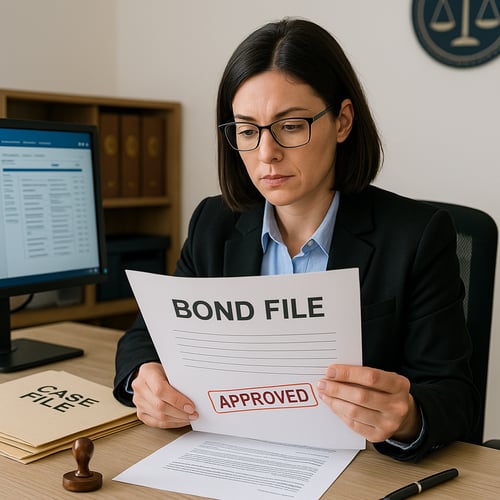
Most attorneys and paralegals know how to file a bond. But very few get a clear look at what happens after the bond is submitted.
What does the clerk actually do with it?
When is the bond “live”?
When can the Fiduciary take action?
What triggers follow-up requirements?
And why do some bonds activate instantly while others get held for review?
Understanding this lifecycle turns you from someone who submits bonds into someone who can anticipate the next steps, guide your Fiduciary with confidence, and avoid the confusion, delays, and last-minute surprises that often occur behind the scenes.
Let’s walk through what really happens, step by step.
1. Clerk-Level Validation: The First Gatekeeper
Once the bond hits the clerk’s office, whether electronically, by email, or by physical drop-off, the very first thing the clerk does is check it for completeness and compliance.
Clerks validate:
- The Fiduciary’s name (must match the order exactly)
- The case number
- The bond amount
- The surety company (must be admitted in Florida)
- Whether the bond is properly signed
- Whether the bond format matches their division’s requirements
Depending on the county, clerks may also check:
- Whether a restricted depository order is included
- Whether the Fiduciary is the correct party
- Whether the order requiring the bond has actually been entered
If anything is off, the clerk will “kick back” the bond or put it in a pending queue and this is where most delays occur.
But if everything is clean and correct? The bond advances to activation.
2. Judicial Review (When Applicable)
Not every bond gets sent to a judge.
It depends on the county and the type of case.
Probate
In many Florida probate divisions, the clerk can activate the bond without judicial involvement, as long as the order requiring the bond is clear and the bond matches.
Guardianship
More courts require judicial oversight because vulnerable parties (minors, adults with incapacity) are involved.
A judge may review:
- The Fiduciary role
- The bond amount
- Whether any money needs to be restricted
- Whether the Fiduciary has been properly vetted
- Whether a supplemental bond is needed
Judicial review doesn’t mean delay, it just adds one more checkpoint before activation.
3. Activation Timelines: When the Bond “Goes Live”
This is the point that matters most to attorneys and Fiduciaries.
A bond is considered active when:
- It has been approved by the clerk,
- Entered into the court record,
- And “accepted” for the case.
This is the moment the Fiduciary gains authority to act.
Typical activation timelines in Florida:
- Fastest cases: 10–60 minutes
- Average cases: Same business day
- Clerk backlog: Next business day
- Judge-involved cases: 1–3 days
Activation may slow during:
- Holidays
- Mondays
- End-of-month accounting periods
- Emergency docket weeks
- Staff transitions
Many attorneys think activation takes long because of the bonding agent, but 90% of delays happen inside the clerk’s office, not with the surety.
4. Required Notices: Who Gets Informed and When
Once the bond is active, certain parties must be notified.
Depending on the case type, this may include:
- The Fiduciary
- Opposing counsel
- Beneficiaries
- Interested parties
- Financial institutions (especially restricted accounts)
- The guardianship monitor
Some counties send automated notices. Others require attorneys to circulate them manually. This step is often overlooked, and missing a notice can delay Letters or future filings.
5. Letters of Administration or Letters of Guardianship Are Issued
After the bond activates, the court can finally issue:
- Letters of Administration
- Letters of Guardianship
- Letters of Curatorship
This is the moment when the Fiduciary truly gains authority. Most attorneys describe this as the “go time” moment: banks open accounts, houses get listed, claims get paid, and cases finally move.
6. Post-Appointment Obligations Begin Immediately
This is the part many Fiduciaries are unprepared for, and where attorneys can shine as advisors.
In Probate:
- Collect and secure estate assets
- Open estate accounts
- Notify interested parties
- Begin inventory preparation
- Manage property responsibly
- Track financial activity for the accounting
In Guardianship:
- File the initial Inventory
- Complete the guardianship plan
- Ensure funds are deposited into restricted accounts
- Begin recordkeeping for the annual accounting
- Maintain strict separation of Ward and Guardian funds
Courts expect Fiduciaries to follow the rules from day one, and they do not give grace for learning curves.
7. Annual Reporting Obligations (Guardianship Heavy, Probate Occasional)
Guardianship reporting is rigorous in Florida. Wards must be protected, and the court wants to ensure continued accuracy and safety.
Required filings usually include:
- Annual Accounting
- Annual Plan
- Verification of receipts
- Proof of restricted account maintenance
- Updated asset valuations
- Documentation of expenditures
Probate doesn’t always require annual reporting, but supplemental inventories or amended accountings may trigger new bond requirements.
When assets change, the court may require:
- A supplemental bond
- Or a restriction order
- Or both
This is part of the normal lifecycle, not a sign of trouble.
Final Thoughts: Why This Knowledge Makes You a Better Advisor
When you understand what happens after the bond is filed, you don’t just process documents you guide your client with confidence.
You can:
- Set expectations accurately
- Prevent stress
- Avoid miscommunication
- Reduce clerk delays
- Prepare Fiduciaries for their responsibilities
- Move cases forward faster
- And protect your own reputation with the judge
The bond may seem like a small step, but it is often the gate that determines how smoothly the entire case will run. If you ever want help navigating a post-bond situation or you need a bond issued now, my team is here to support you every step of the way.
If you need a bond now, call 800-828-2226 or Click Here.
To your success,
Darren Vermost
The Bond Guy
and the Probate Bond Pros Team